自然语言处理导论
ftp://dl4nlp2026:nlp2026@10.214.112.254
主机: 10.214.112.254
用户: dl4nlp2026
密码: nlp2026
端口: 留空
Lecture 1:Introduction
Lecture 2:Deep Learning Basics
machine learning:f(input) = output,f is the learnt model
1. define a set of function and train the models using training data
2. evaluate the goodness of function f
3. pick the best function f*
Neural Network:omitted
shallow and wide vs. deep and narrow:same number of parameters but deep means more pieces(piecewise linear,the addition of more linear functions)
training data:loss minimization
best function selection:gradient descent
pick the initial value of w
compute \(\partial L/\partial w\)
move \(-\eta\partial L/\partial w\),\(\eta\) can be defined using weight decay/adam(adaptive momentum)
problem of adam:memory of second-derivative
Muon(24.12):low-rank,sparse matrix \(M\approx N=OO^\top= U^\top IV\)
local minima,saddle point(鞍点),plateau
Lecture 3:Word Embedding
Manifold assumption语义流形:通过一个空间,在这个空间移动可以进行语义的比较
represent the meaning of a word:
- discrete representation/one-hot([0,0,...,0,1,0,...,0])
no natural notion of similarity
- Distributional similarity based representations/word2vec
continuous bag-of-word (CBOW):eat an __ every day -> apple
skip-gram (SG):apple -> eat an every day
输入词->预测上下文->计算与窗口上下文词的误差(熵)->反向传播
hierarchical softmax:huffman encoding
negative sampling:对不在上下文的词给低分(对比学习)
Application:
- Word similarity
- Machine translation
- Part-of-Speech and Named Entity Recognition
- Relation Extraction
- Sentiment Analysis
- Co-reference Resolution
- Clustering
- Semantic Analysis of Documents
Limitations:
- ambiguity
- debuggability(颜色区分困难)
- sequence(顺序)
Lecture 4:RNN
RNN
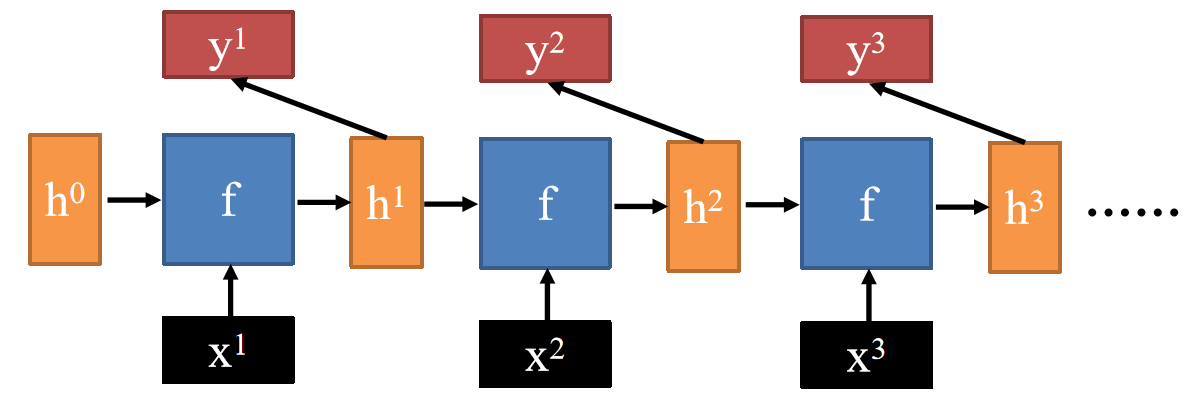
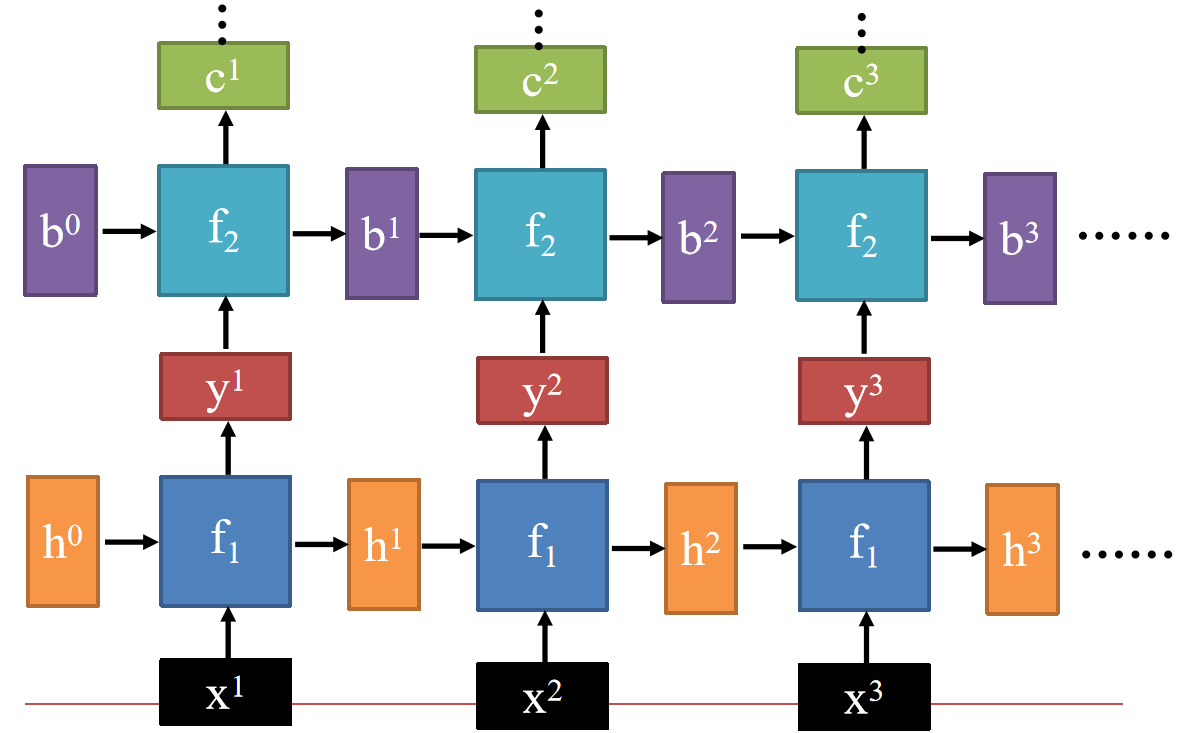
Deep-RNN
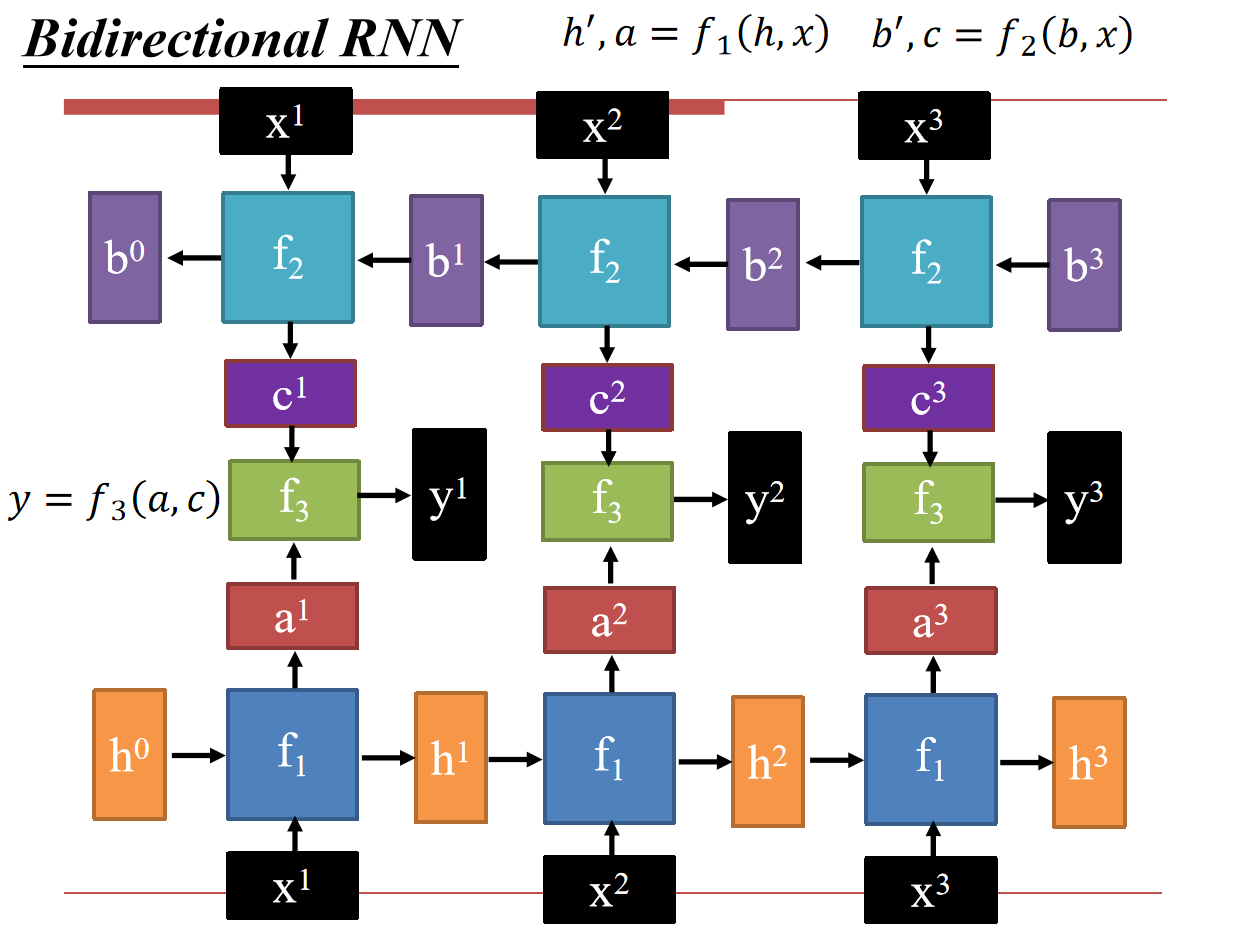
Bidirectional-RNN
Naive RNN and LSTM
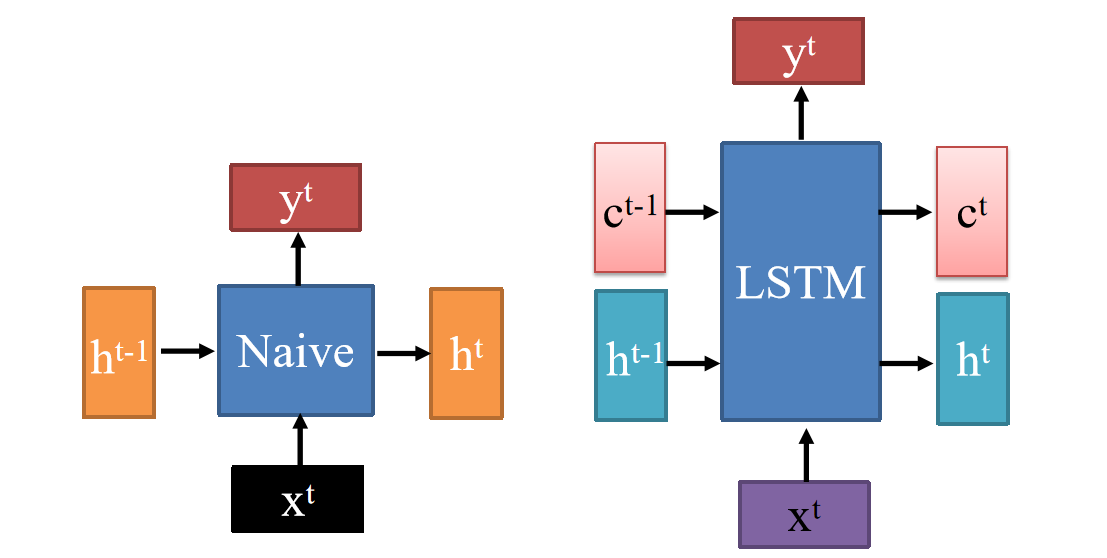
where \(c\) changes slowly and \(h\) changes faster
input gate:\(z^i=\sigma(w^ix^th^{t-1})\)
forget gate:\(z^f=\sigma(w^fx^th^{t-1})\)
output gate:\(z^o=\sigma(w^ox^th^{t-1})\)
\(z=tanh(wx^th^{t-1})\)
\(c^t=z^f\otimes c^{t-1}+z^i\otimes z\)
\(h^t=z^o\otimes tanh(c^t)\)
\(y^t=\sigma(W'h^t)\)
GRU:\(h^t=z\otimes h^{t-1}+(1-z)\otimes h'\)
stacked LSTM,nested LSTM
RNN for NLP
representing a sentence:classification,conditioned generation,retrieval
representing a context within a sentence(read context up until that point):tagging,language modeling,calculating representations for parsing
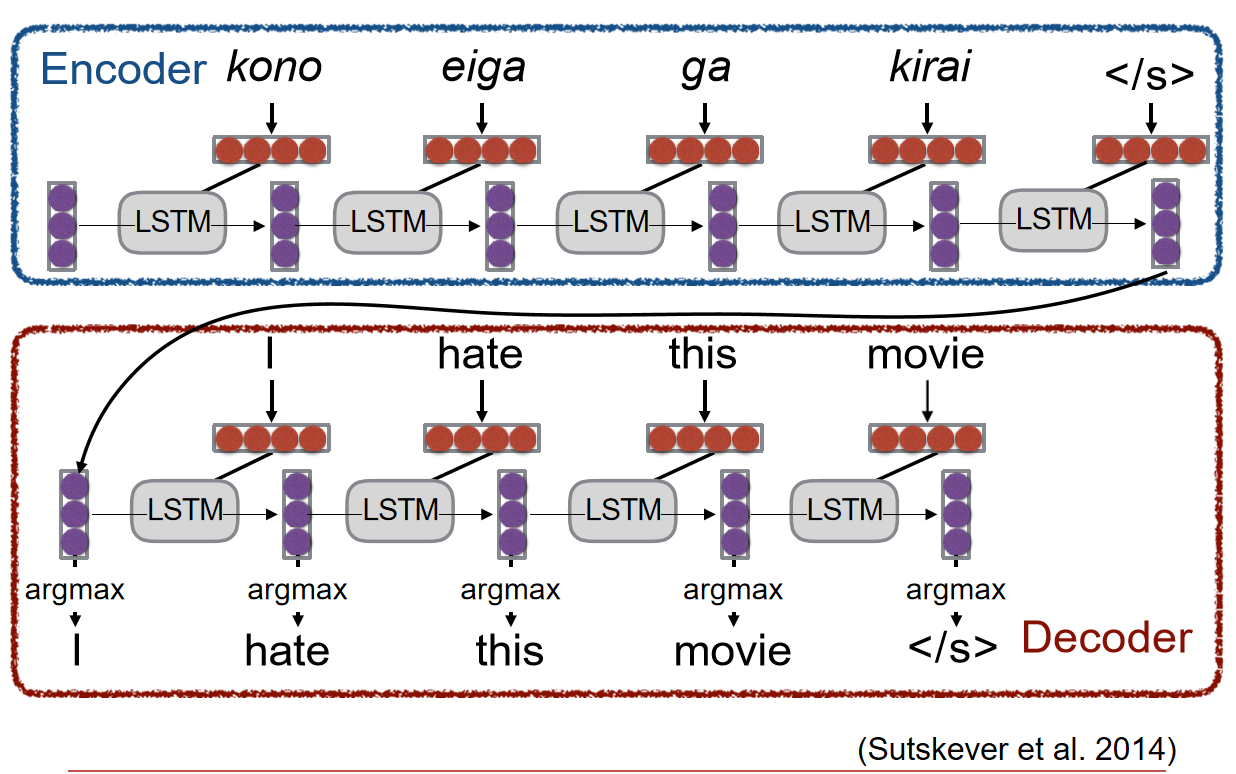
Encoder-decoder model for translation
Attention
sentence-vector encoding
decoding:linear combination of vectors using attention weights
calculate weight for each query-key pair,then softmax
combine together value vectors by taking the weighted sum
attention score function:scaled dot product
$$
a(q,k)=\frac{q^Tk}{\sqrt{|k|}}
$$
pointer network
looking for a convex hull(find a few points to wrap all the points)
Seq2seq model:output size of decoder is fixed, not suitable for dynamic results
attention mechanism
encoder:city coordinates
decoder:attention scores as probability and choose the highest point
Lecture 5:Natural Language Generation and Neural Machine Translation
NLG
[Definition] any text generation,including translation,summarization,dialogue,creative writing,question answering,image captioning,...
Language modeling(next token prediction):\(P(y_t|y_1,...,y_{t-1})\) called:RNN-LM
Conditional LM(with input x):\(P(y_t|y_1,...,y_{t-1}|x)\),encoder-decoder
faster generation dLLM:从噪声矩阵开始,每步同时预测所有位置(依据置信度评估的渐进式解码)
training process(Teacher Forcing):每次token prediction都由一个“teacher”给出正确答案
schedule sampling:逐渐增加用自己输出token进行prediction的概率,提高抗风险能力
decoding algorithm
argmax(greedy)/sampling
sentence generation:argmax/sampling(still sometimes same answer due to KV-cache)
pure sampling:greedy decoding,top-n sampling:samples restricted in top-n most probable words
beam search
beam search decoding:On each step of decoder, keep track of the k most probable partial sequences (which we call hypotheses)
e.g. Given a generated sequence:I am with next token probability:a=0.4,very=0.3,not=0.2,the=0.1,K=2
preserve the top-K=2 sequence:I am a,I am very with next token probability:
I am a:student=0.5,teacher=0.3,person=0.2,I am very:happy=0.6,excited=0.3,sad=0.1
Then the probabiity of sequence:I am a student=0.20,I am a teacher=0.12,I am a person=0.08,I am very happy=0.18,I am very excited=0.09,I am very sad=0.03,then preserve the top-K=2 sequence:I am a student=0.20,I am very happy=0.18,repeat.
beam size K:
- small:similar to greedy
- large:\(P(sentence)=P(w1) × P(w2) × ... × P(wn)\) means the model will prefer short answers;boring and general answer(I don't know) because general words have slightly larger probability
temperature
softmax:\(P_t(w)=\frac{\exp(s_w)}{\sum_{w'\in V}\exp(s_{w'})}\)
temperature parameter \(\tau\):\(P_t(w)=\frac{\exp(s_w)/\tau}{\sum_{w'\in V}\exp(s_{w'}/\tau)}\)
higher temperature means more creative answers,because it smooths the probability of next token
z=[2.0, 1.0, 0.5]
T=0.5
z/T = [4.0, 2.0, 1.0]
exp(z/T) = [54.6, 7.4, 2.7]
概率 = [0.84, 0.11, 0.05]  # 高度集中在最高分
T=1.0
z/T = [2.0, 1.0, 0.5]
exp(z/T) = [7.4, 2.7, 1.6]
概率 = [0.63, 0.23, 0.14]  # 保持原始分布
T=2.0
z/T = [1.0, 0.5, 0.25]
exp(z/T) = [2.7, 1.6, 1.3]
概率 = [0.48, 0.29, 0.23]  # 分布更均匀
evaluation
human evaluation
BLEU:how many n words in sequence(n-gram) matches the reference
e.g. Reference=Taro visited Hanako,System=The Taro visited the Hanako,1-gram=3/5,2-gram=1/4
brevity(too short generation penalty)=min(1,|System|/|Reference|)=1
\(BLEU_2=(3/5*1/4)^{1/2}*1=0.387\)
bad for comparing very different systems
METEOR:consider recall(for lacking information),hierarchical matching:precise matching,stem(词干) matching,synonym(同义词) matching,order penalty
Perplexity困惑度:how many candidate words are there for each prediction in average
文本: "The cat is sleeping"
模型预测概率:
- P("The" | start) = 1.0
- P("cat" | "The") = 1.0
- P("is" | "The cat") = 1.0
- P("sleeping" | "The cat is") = 1.0

计算:
几何平均 = (1.0 × 1.0 × 1.0 × 1.0)^(1/4) = 1.0
Perplexity = 1/1.0 = 1.0 ✅

文本: "The cat is sleeping"
模型预测概率:
- P("The") = 0.8
- P("cat" | "The") = 0.6
- P("is" | "The cat") = 0.7
- P("sleeping" | "The cat is") = 0.5

计算:
几何平均 = (0.8 × 0.6 × 0.7 × 0.5)^(1/4)
         = (0.168)^(1/4)
         ≈ 0.639
Perplexity = 1/0.639 ≈ 1.56
# 模型平均在 1.56 个词之间犹豫
Neural Machine Translation
RBMT(rule-based),EBMT(example-based),SMT(statistical),NMT(neural)
SMT:\(argmax_yP(y|x)\propto argmax_xP(x|y)P(y)\)
\(P(x|y)\rightarrow P(x,a|y)\),假设存在已知分布的隐变量\(a\),通过概率估算隐变量的结果
对齐alignment:人工标注单词翻译间的对应关系,can be one-to-many,many-to-one,many-to-many
NMT:(bidirectional) encoder-decoder framework
seq2seq model:very long training,translation breaks down for long sentences
V1:encoder-decoder
V2:Attention based encoder-decoder
V3:Bi-directional encoder layer
V4:multi-layer/deep encoder and decoders
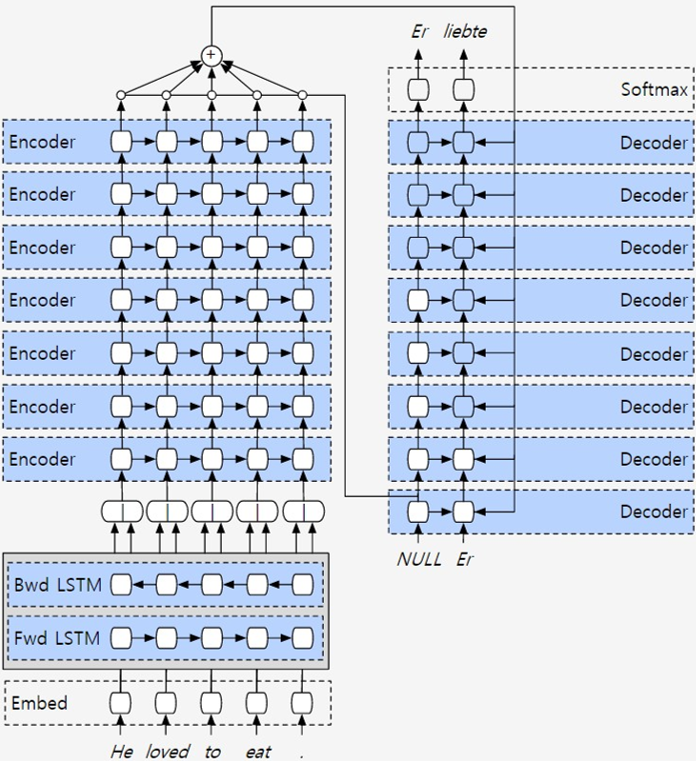
V5:parallelization
V6:residuals to solve vanishing gradients
translation quality:human evaluation from score 0-6
[problem] not scale
[solution] multilingual model:prepend source with additional token to indicate target language,e.g.<2en>,to english
zero-shot translation:given English-Korean,English-Japanese translation,Korean-Japanese translation can be achieved zero-shot
code-switch:语言混杂 is allowed
Lecture 6:Transformers(1)
self-attention
input:\(x^i\),word vector:\(a^i=Wx^i\),\(q,k,v=W^{q/k/v}a^i\)
scaled dot product attention:\(\alpha_{1,i}=q^1\cdot k^i/\sqrt{d}\)
\(\alpha_{1,1},\alpha_{1,2},\alpha_{1,3},\alpha_{1,4}\rightarrow softmax\rightarrow\hat{\alpha}_{1,1},\hat{\alpha}_{1,2},\hat{\alpha}_{1,3},\hat{\alpha}_{1,4}\)
\(b^1=\sum_i\hat{\alpha_{1,i}}v^i\)
\(b^1,b^2,b^3,b^4\) can be computed in parallel
all matrix multiplication,accelerated by GPU
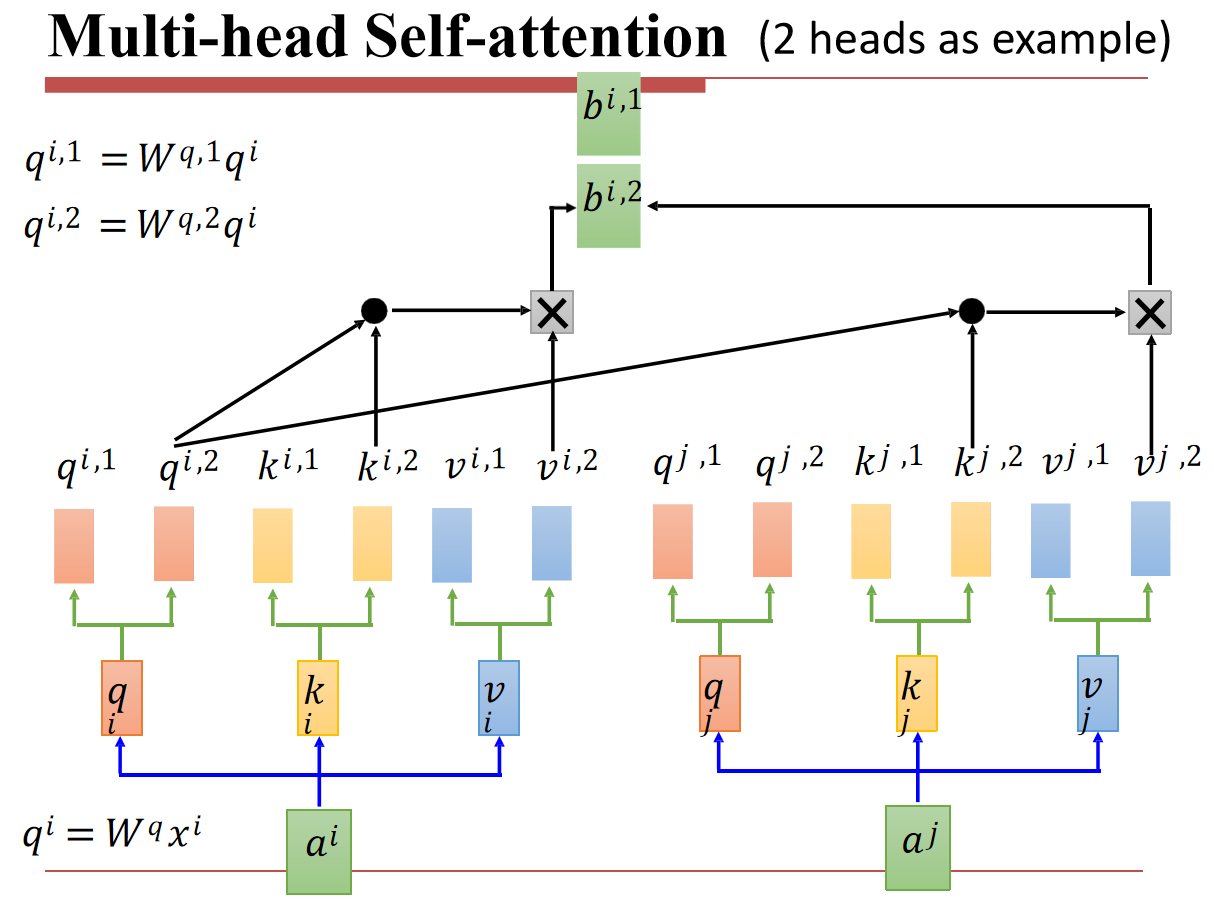
multi-head self-attention
different head(query vector) focuses on different aspects
elf-attention的计算是对称且无序的,无法感受到词语在序列中的先后顺序,需要positional encoding显式注入位置信息
positional encoding:a unique positional vector(each \(x^i\) appends a one-hot vector \(p^i\))
Sinusoidal位置编码
RoPE旋转位置编码:通过旋转矩阵来编码单词在序列中的绝对位置,同时让注意力机制自然地感知到相对位置
计算注意力时,两个向量之间的角度差(即旋转后的方向差异)自然地表达了它们在序列中的距离远近
Transformer
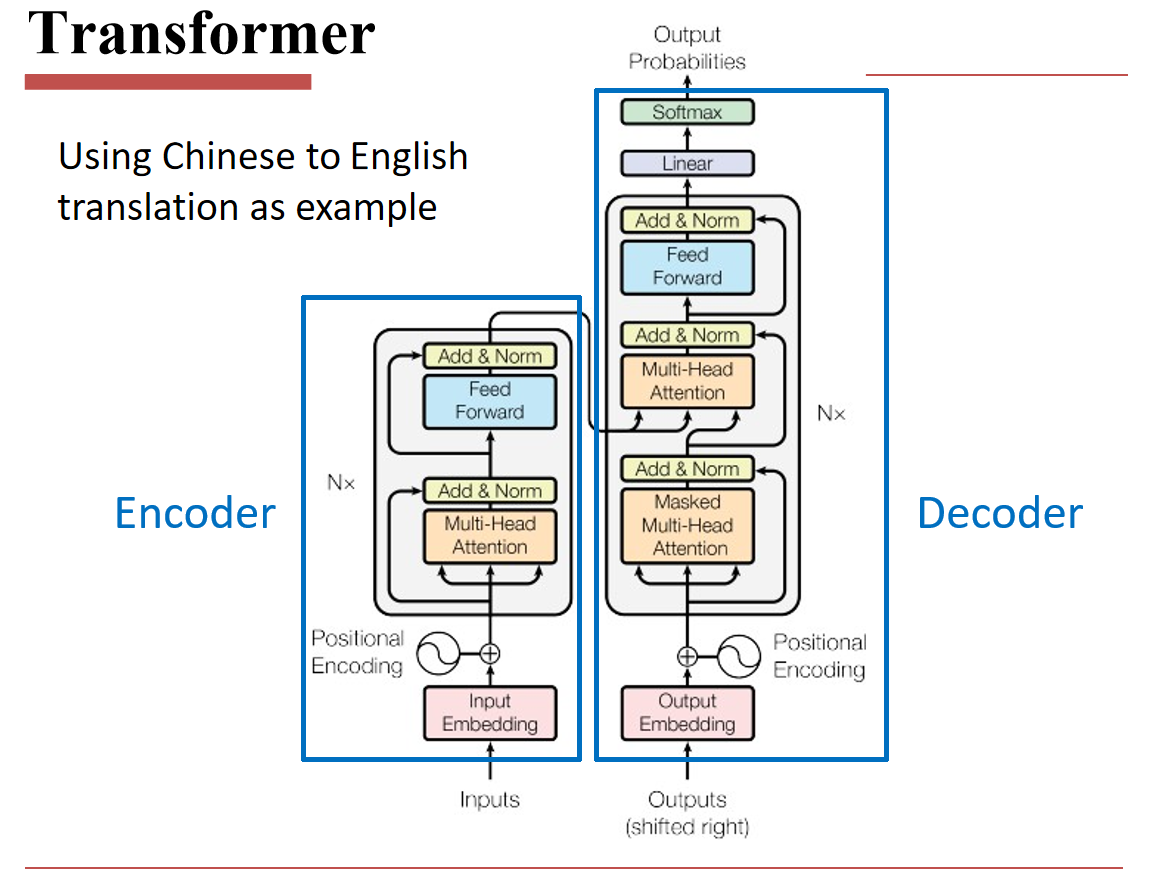
Add & Norm:Residual link:\(a + b\);layer normalization
layer normalization:单样本归一化(包括均值,方差,可学习的缩放和平移参数)
feed forward:very large MLP
MoE混合专家:复制多份FFN(多个专家),每个token只去几个专家,批量token路由发送数据
Lecture 7:Transformers(2)
MLP Mixer
for images
\(channels * patches\stackrel{T}{\rightarrow} patches * channels\rightarrow MLP_1\stackrel{T}{\rightarrow}channels * patches\rightarrow MLP_2\rightarrow Mixer\)
greatly reduce time complexity(transformer:\(O(N^2)\))
not gain popularity because of kv-cache
Mamba
a challenger of Transformer
recall RNN:\(H_t=f_{A,t}(H_{t-1})+f_{B,t}(x_t),y_t=f_{C,t}(H_t)\)
并行训练:ignore forget gate:\(f_{A,t}\rightarrow\) linear attention:\(H_t=H_{t-1}+v_tk_t^T,y_t=H_tq_t\)
linear attention is RNN without forget gate \(f_{A,t}\)
linear attention is self-attention without softmax
retention network(RetNet):\(H_t=\gamma H_{t-1}+v_tk_t^T,y_t=H_tq_t\)
gated retention:\(H_t=\gamma_t H_{t-1}+v_tk_t^T,y_t=H_tq_t,\gamma_t=sigmoid(W_{\gamma}x_t)\)
more variants:\(H_t=G_t\otimes H_{t-1}+v_tk_t^T,G_t=e_ts_t^T\)
Mamba:linear attention with variants
pretrain model
tokenized vector embedding:Word2Vec,FastText(char),CNN
contextualized world embedding:LSTM,self-attention layers,tree-based model
smaller model
- network pruning
- knowledge distillation(teacher&student)
- parameter quantization
- architecture design(transformer-XL:segment-level recurrence with state reuse)
fine-tune
pretrained model + task-specific layer
input:one sentence,multiple sentences(using special token:[SEP])
output
- one class:special token [CLS]
- class for each token:classifier for each token
- copy from input(extraction based Q&A)
- general sequence:pretrained model as encoder,task specific as decoder?\(\rightarrow\)encoder as decoder(input sequence + [SEP] + output sequence),but the model sees the input and output(answer) together
[Solution] 因果注意力(causal attention):掩码矩阵使llm只能看见先前的位置
Lecture 8:How to train your LLM
Adaptor
small network after feed-forward for PERT
often a bottleneck forward network:先降维,激活,再升维
LoRA(Low-Rank Adaptor):a layer mount beside the main network(flexible)
weighted features
feedforward:layer 1 -> x1 -> layer 2 -> x2 -> w1x1+w2x2 -> task specific(w1,w2 is learnt in downstream tasks)
How to pretrain
self-supervised learning:given a sequence/image/...,predict some part of it based on the other parts
masking input,encoder as decoder,causal attention,bidirectional next token prediction
LLM implementation
- forward & backward:input -> weights -> loss -> backpropogation -> gradient -> weights
- memory:for 8B model,weights=32GB,adamW momentum=32GB,variance=32GB,fp16 computation on GPU:weights=16GB,gradients=16GB,total=128GB
- activation:16k tokens context -> 32 layers * (attention=40GB + feed forward=2.2GB)=1.35TB
- batch size:generally 4-60M tokens per batch(DeepSeek V3:batch size=1920 for 32K context,61M tokens)
global batch size = mini batch size * gradient accumulation
parameters,gradients and optimizer states
DeepSpeed-Zero Redundancy Optimizer (ZeRO):
Zero-1:optimizer separation(leveraging bandwidth for transmitting,NVLink)
Zero-2:gradient separation
Zero-3:model parameters separation(commonly used,not recommended)
Zero-Offload:GPU->CPU communication,very slow
activations
- kernel:PyTorch -> torch.compile() -> Triton -> CUDA
- flash attention:\(O(N^2)\rightarrow O(N)\)
store Q,K,V in CPU,computing by transmitting blocks to GPU - Liger kernel(optimized Triton code)
AutoLigerKernelForCausalLM
quantization
- lossy compression:32 bit精度->8/4/2/1bit
Lecture 9:Model compression and Data-efficient fine-tuning
quantization
post-training:floating point numbers
int8 quantization:[0.5,20,-0.0001,-0.01,-0.1]
max = 20
round(127/20 * [0.5,20,-0.0001,-0.01,-0.1])=[3,127,0,0,-1]
model-aware quantization:
GOBO:BERT weights in each layer fit a Gaussian distribution -> quantize 99.9% of parameters and remain the 0.1%
LLM.int8:8-bit vector-wise quantization for 95% normal parameters + 16-bit decomposition for outliers
quantization-aware training
binarized neural network:weights are -1 and 1 everywhere
Layer-by-Layer Quantization-Aware Distillation:ZeroQuant
memory compression:Q-LORA
pruning
set a number of parameters to zero
Lottery ticket hypothesis:training pruned(delete unnecessary parameters) randomly-initialized network can be better than training full randomly-initialized network
Wanda:pruning matrix \(W\) based on \(S=|W|\cdot \|X\|_2\)
\(W=\begin{bmatrix}4&0&1&-1\\3&-2&-1&-3\\-3&1&0&2\end{bmatrix},\|X\|_2=\begin{bmatrix}1&2&8&3\end{bmatrix},S=\begin{bmatrix}4&0&8&3\\3&4&8&9\\3&2&0&6\end{bmatrix}\rightarrow W'=\begin{bmatrix}4&0&1&0\\0&0&-1&-3\\3&0&0&2\end{bmatrix}\)
problem of unstructured pruning:limited sparse data structure supporting hardware
structured pruning:remove entire components
coarse-to-fine structured pruning:learn masks that control which components to turn off
coarse pruning:entire self-attention or feed-forward components
fine pruning:attention heads and hidden state dimensions
distillation
all parameters are changed student model
training data are generated by teacher model
weak supervision:labels from other places,e.g.remote supervision:label from the third-party
hard target:one-hot label
soft target:probability distribution
born-again NN:teacher -> student 1 -> student 2 -> student k
ensemble student 1 to k:better than teacher
word-level distillation:match the distribution of words at each step with the teacher distribution
sequence-level distillation:maximize the probability of the output generated by the teacher
DistilBERT:initialize with BERT weights;soft target imitation;mask language pretrain task;consine similarity of hidden layer vectors
Self-Instruct:automatic instruction tuning dataset generation
Prompt2Model:prompt -> retrieve data,generate data,retrieve pretrained model -> deployment-read model
Lecture 10:Data-efficient fine-tuning and RL
Adapter:inside Transformer, after Feed-forward, only adapters are updated
LoRA:Low-Rank Adaptation beside Feed-forward
# 标准微调 vs LoRA

# 标准微调(更新所有权重)
output = W·x

# LoRA(只更新低秩矩阵)
output = W·x + ΔW·x = W·x + (B·A)·x
# W冻结不更新
# 只训练A和B
其中: B ∈ ℝ^(d×r), A ∈ ℝ^(r×k), r << min(d,k)
early exit:add a confidence predictor for each classifier after each Transformer layer, early output for enough confidence
semi-supervised learning:few-shot(some labeled training data and a large amount of unlabeled data)
Promptless fine-tuning:直接在预训练模型上添加分类头并微调所有参数,不使用任何提示模板。使预训练模型适应不同的下游任务,如BERT
Fixed-prompt tuning:使用固定的自然语言提示模板,但微调整个模型的所有参数以适应任务。
Prompt+LM fine-tuning:使用可学习的软提示向量,同时微调提示和整个语言模型的所有参数。
Tuning-free prompting:完全不进行任何训练,直接使用精心设计的提示模板引导冻结的预训练模型进行零样本推理,即硬提示学习
Fixed-LM prompt tuning:冻结整个语言模型的所有参数,只训练可学习的连续提示向量(软提示),即软提示学习
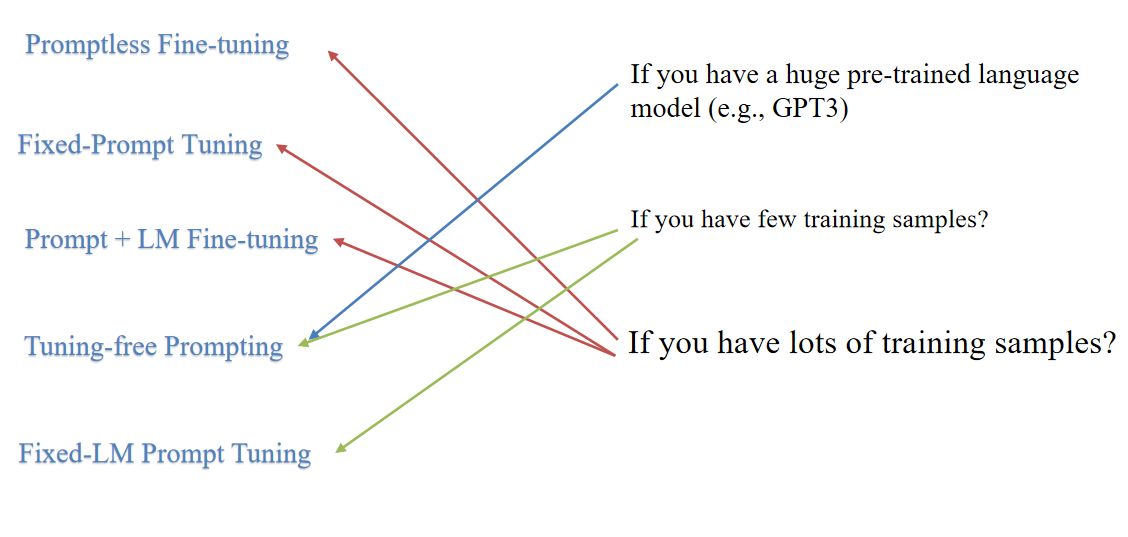
样本多 → 可训练参数可以多 → 充分微调
promptless fine-tuning,fixed-prompt tuning,prompt+LM fine-tuning可训练参数100%,模型参数多不会导致过拟合,可以充分利用数据学习的细粒度特征 样本少 → 可训练参数必须少 → 防止过拟合
tuning-free prompting训练参数0%,fixed-LM prompt tuning可训练参数<1%,利用模型的先验知识,极大降低过拟合风险
RL
see Machine Learning in fa25
Q-learning:action based
policy based:for continuous values
Lecture 11 & 12:GPTs:ChatGPT, GPT-4, and etc
BERT:填词,预训练用于各类nlp任务
GPT:选词接龙,语境学习用于语言生成(无需训练)
语境学习(in context learning):few-shot(example) learning,one-shot learning,zero-shot learning
scaling laws and emergent ability
大模型训练与对齐
pretraining,post-training/alignment(SFT,RLHF持续学习/终身学习)
pretrain
以盘古为例
语料->算法->框架->评测
垃圾文本过滤:人工精细化评估+盘古α小模型快速批量验证,大规模降低文本数据量
大集群训练:内存墙、性能墙、效率墙、调优墙
解决方法:scale out并行、scale up内存优化
大集群训练快速故障恢复:CKPT保存、故障检测隔离、资源重调度、加载CKPT、恢复
supervised fine-tuning(SFT)
Pretrain style:人工智->能
SFT style:input:USER:你是谁?output:我是->...(遵循结构化回答数据)
Non-instructional fine-tuning:直接用输入-输出对进行任务微调
less is more for alignment,quality is all you need(RuoZhiba)
ChatGPT:GPT3.5->指令微调->人类反馈->RL
人类反馈的强化学习(RLHF)
RL style:Q:杭州最高山是哪座?A:不知道(bad)/如意尖(good)
Proximal Policy Optimization(PPO)
policy gradient:trajectory \(\tau = \left\{s_1,a_1,s_2,...,s_T,a_T\right\}\)
\(p_{\theta}(\tau)=p(s_1)p_{\theta}(a_1|s_1)p(s_2|s_1,a_1)p_{\theta}(a_2|s_2)p(s_3|s_2,a_2)...\)
\(R_{\theta}=\sum_{\tau}R(\tau)p_{\theta}(\tau)=\mathbb{E}[R(\tau)]\)
\(\nabla R_{\theta}=\sum_{\tau}R(\tau)\nabla p_{\theta}(\tau)=\sum_{\tau}R(\tau)p_{\theta}(\tau)\nabla\log p_{\theta}(\tau)\)
problem:policy gradient is based on random sampling,so it leads to data inefficiency and unstable update
solution(PPO):make effective use of limited data
1. mini-batch training(on-policy -> off-policy/observing) using importance sampling
e.g. sample from Gaussian distribution using uniform sampling(25% accept < -0.5,25% accept >0.5,50% accept between -0.5 and 0.5)
无偏high variance
2. regularization KL
3. clip objective
Catastrophic Forgetting
catastrophic forgetting because of parameters changed by SFT(not only deliberate attack)
result:security loss,general knowledge forgets
large models doesn't perform better in forgetting prevention
LoRA learns less forgets less
tradeoff:professional competence increases,general ability losses
[Solution] experience replay/memory bank:reserve some training data while fine-tuning
[Problem] training data is not open-source
[Solution] distillation from the LLM
pseudo experience replay(paraphrase):input data from the Internet -> ask the model to paraphrase -> add them into the fine-tuning data
Lecture 13:reasoning model
Deepseek
GPT-o1 for training
V3:非推理模型提示工程:角色,功能,技能,约束,工作流程,输出格式,示例
推理模式:模型自制提示词
架构设计
DeepSeekMoE:(Mistral:8 experts,Grok:20)671B model with 58 MoE layer,each layer(except the first three) consists of 1 shared expert and 256 router experts.
Each layer activate 1 shared expert and 8 router experts -> 37B
H800硬件稍弱,冗余专家可以避免异常
Why MoE?
Large model needs to be separated into many devices -> high requirement for communication -> NVIDIA NV-link 900G/s but has a limit of 1000 GPUs -> more GPUs need pod集群 network -> high cable communication latency
[Solution] SYNC system at NV-link -> system connect by cables -> MoE for ASYNC pods -> faster and easier development
Multi-Head Latent Attention(MLA):降维QKV存储到cache
Multi-Token Prediction(MTP)
量化训练
FP8
混合精度细粒度量化:激活->1 128 tile条形分组,权重->128 128 block分块
乘法量化FP8,加法高精度FP32
FP4 for scaling factor(指数范围)
并行计算
16路流水线+64路专家并行,ZeRO-1
DualPipe双向流水线,reduce bubble;warp specialization计算与通信重叠;内存优化重计算
推理模型
o1-preview:quiet thought(latent space非自然语言token),inference-time scaling
question ->
Test-time compute(in AlphaGo):MCTS
Test-time scaling:scaling scaling law:longer test-time compute(reasoning) can complement train-time compute,achieving similar performance
CoT
short CoT:few-shot CoT(examples),zero-shot CoT('Let's think step by step')
long CoT
模型推理工作
input -> 'give me the first step' -> output many first steps -> 'this first step is good,now give me the second step' -> ...
[problem] how do we know which step is good?
Long CoT can be only guided out in some strong LLMs
[solution] large language monkeys:足够多尝试,模型可以得到正确答案
Majority voting:同一个问题多问几次,选出最多答案/最高confidence的答案
Best-of-N:verifier(another LLM) gives a score for each output
knowledge distillation
feed the reasoning process of a reasoning model to a base model
RL
DeepSeek-v3-base use RL(neglect reasoning process,only focus on answer) with accuracy as reward -> DeepSeek-R1-Zero
Aha Moment
R1-Zero only for math and coding
use R1-Zero + data synthesis数据合成,human annotation,few-shot prompting,direct prompting for reflection and verification -> imitation learning
v3-base use imitation learning -> model A,then RL with reward of accuracy and language consistency -> model B,then v3 as verifier(GRPO,Group Relative Policy Optimization)
v3-base use imitation learning of the result of model B + verifier -> model C,then RL with reward of safety and helpfulness -> DeepSeek-R1
多路径推理
[problem] overthinking for easy question,give up for very difficult problem
[solution] 模型选择;输出长度限制;多路径推理与结果聚合,利用硬件并行计算
adaptive parallel reasoning:自适应并行推理
parallel method:sample K answers and score independently,then select the highest score one
sequential method:LLM is trained to extend reasoning path until reaching correct answer
sample set aggregator样本集聚合器:hybrid of parallel and sequential method
质疑
推理相比提示词工程是否有用
RL收益大小
悖论性行为(复杂问题时放弃)
干扰信息("Interesting fact:cats sleep for most of their lives")
对抗性触发:overthinking
轻微分布导致模型下降(改变数字)
CoT限制会导致不连贯步骤
强制模型以用户语言思考导致准确率降低
Lecture 14 & 15:LLM development trend
专业模型与检索增强
gigantic LLM training set for pretraining,specific knowledge base for fine-tuning -> fine-tuned LLM
smart retriever look-up specific knowledge base by index embedding(kv vector database)
question + relevant documents as asking input
context window
the needle in the haystack test:大海捞针
通用模型 + 无限上下文 ≠ 专业模型
context rot上下文腐烂:中间信息缺失
context engineering
context:instructions/system prompt,long-term memory,state/history(short-term memory),user prompt,retrieved information(RAG),avaliable tools,structured output
[problem] system prompt与tool output输出量不协调,导致关键信息遗忘
context engineering:
- write context
- long-term memories(across agent session) -> cloud
- within agent session -> scratchpad
- state(within agent session) -> file system/database
- select context
- retrieve relevant tools
- retrieve from scratchpad
- retrieve long-term memory
- retrieve relevant knowledge
- compress context
- summarize context to retain relevant tokens
- trim(删除) context to remove irrelevant tokens
- isolate context
- partition context in state
- hold in environment/sandbox
- partition across multi-agent
模型
开源与闭源
领域模型与垂直模型
算力
- Blackwell Ultra架构
- Rubin平台
- 边缘计算设备
专用芯片
TPU v7——ironwood
存算一体芯片
数据
多模态:教育,图表理解与数据推理,内容生成,调研
联觉:可控知识注入机制,图像->文本instruction-specific visual-prompt
Momentor:视频大模型,细粒度时间理解
语音合成大模型:NaturalSpeech3,因子化扩散模型实现零样本语音合成
GPT-4o:realtime conversational speech
New Tokenizer:Auto-Encoding Morph-Tokens
视觉理解:丢弃部分特征进行视觉抽象
视觉生成:尽可能保留视觉细节
图像-文本对统一自回归训练,文本自回归图像重建,基于指令微调的文本自回归
增量式模态扩展
HealthGPT
混元视频(Sora)
视频生成LanDiff
Sora2
Seedance 2.0
算法
GPT-4:调用工具,角色扮演,agents
多样化agent研究:tools,planning,memory,MAS,evaluation,coding agent,research agent,generalist agent
multi-model agent:HuggingGPT
AutoGPT
通用虚拟智能体(浏览器)
推荐系统
openclaw:context engineering
应用
通用机器人
Helix
世界模型:对物理世界的因果理解,关于环境如何运作的抽象表征,感知,预测,推理
思考
认知与感知,未来与担忧